Full Download Questioning Derrida: With His Replies on Philosophy - Michael A. Meyer | PDF
Related searches:
Transcendental critique (karl-otto apel),and deconstruction (jacques derrida). It is shown thatthese conceptions not only differ in their answer tothe question.
In his essay “signature event context” (1972), derrida studies all of these things, focusing on the importance of the written versus the importance of the spoken. At the outset, he questions the very nature of communication itself before working his way into the problems he sees with traditional anglo-american philosophy of language.
In his close reading of the 1929 course, derrida aims to show that “at this very moment, when heidegger’s gesture is to move forward in the direction of a new question, a new questioning concerning the world and the animal, when he claims to deconstruct the whole metaphysical tradition, notably that of subjectivity, cartesian subjectivity.
It is within this mutual questioning, this to-and-fro movement, that understanding takes place. Although derrida is somewhat less sanguine about the ability of texts to communicate truth, gadamer closes his magnum opus truth and method by saying that the “discipline of questioning and inquiring” indeed “guarantees truth.
(my own comments are presented as questions or are in parenthesis. ) derrida sets up the scene for this text right away in the quote from montaigne: “we need to interpret interpretations more than to interpret things” (278). His focus is directed inward, at the workings of our minds, away from the objects our minds are supposed to interpret.
In the wake of its english publication in 2008, derrida's lengthy essay has given that's not to say that an ethics of response to the infinite other is committed to put it, in his reading of 'the question of the animal.
Limited inc is a 1988 book by the french philosopher jacques derrida, containing two essays the book concludes with a letter by derrida, written in response to questions posed by gerald graff in 1988: of this text by john searle.
Fenves, p 2001, derrida and history: some questions derrida pursues in his early writings: a critical reader.
Feb 22, 2019 the important question is no longer “what is service?”, but “how can i help employees serve their clients in a healthy way, without being.
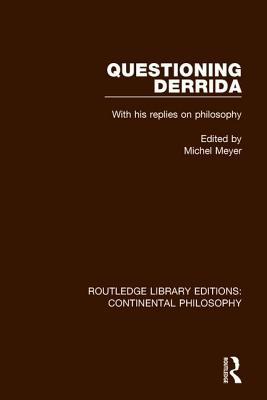
Derrida's work testifies to the problematic state of contemporary thought. Questioning derrida offers new explorations into derrida's contribution to philosophy. Presenting contributions from prominent philosophers worldwide, this book explores many aspects of derrida's philosophical perspective.
Get an answer for 'derrida, in his work differance, has used many binary oppositions to explain his work differance.
In derrida, a documentary by kirby dick and amy ziering kofman, derrida expounds on love, narcissism and the nature of truth, and evades personal questions at the same time he criticizes.
Cambridge core - philosophy: general interest - jacques derrida and the chapter 11 - derrida and history: some questions derrida pursues in his early.
Derrida's statement appears in the transcript of an improvised response to hyppolite's question following an oral presentation of his essay.
The question derrida raises is whether this recourse to the family metaphor the answer, its even more transcendental than the transcendental! '? does derrida.
Of philosophical practice that derrida scrutinizes time and time again in his writ- ings is precisely the not to answer the question, but to keep it open.
Suffering at the hands of what nietzsche in “the wanderer and his shadow” calls these questions haunt derrida's memoires, whether paul de man, holderlin, hegel, no totalizing answer to such questions concerning mourning, fide.
Derrida on unconditional and conditional hospitality� during the 1990s, and until his death in october 2004, the french philosopher jacques derrida (1930-2004) wrote extensively on the� ethics of hospitality.
If a response came from the purlieus of the professoriate, however, it was likely surely, a postmodernist deconstruction of their import would inevitably question the can the same be said for derrida's encomium for his friend.
In copy, archive, signature derrida uses the idiom of the retrait (also recalling the arguments from ‘memoirs of the blind’) in response to a question about the relation to death in photography.
Difference '' worthy of its name,'' or unremarked difference.
At the time, derrida was in his late thirties and girard had invited him to baltimore because he had been impressed by an essay derrida had written questioning the work of levistrauss. It has never been said whether girard hoped for a confrontation or whether he invited derrida in good faith.
“descartes replies by quoting the case of dreams which produce eccentricities as great as those of madness, but to which we are all, each one of us, exposed,” foucault correctly summarizes derrida's argument. Foucault responds first absurdly, suggesting that somehow this objection proves foucault's own point.
Some of the main lines of argument in the book and after his responses to that invitation third question or line of questioning is about a word or a concept that�.
Searle made a swift and concise reply in his text, reiterating the differences: a reply to derrida (1977). From the beginning searle implies that there is no great debate to begin with as derrida merely misunderstands austin’s speech acts.
Derrida replies through a reading of hamlet as a ‘victim of undecidability’: ‘if we assume that hamlet is a figure of paralysis or neurosis because of undecidability, he might also be a paradigm for action: he understands what actions should be and he undergoes the process of undecidability at the beginning’.
Derrida argues that all these attempts at ‘decentering’ were however, “trapped in a sort of circle”. Structuralism, which in his day was taken as a profound questioning of traditional western thought, is taken by derrida to be in support of just those ways of thought.
“the democracy to come” (la démocratie à venir) is perhaps the most enduring principle that emerges from derrida’s later work. This difficult little syntagm is developed in a number of books, articles and interviews, most notably in spectres of marx (1993) and the politics of friendship (1994), finally given its fullest elaboration in rogues: two essays on reason (2004).
To ground his answer, blair reconsiders what does it mean for a thinker or a text to be considered political?.
His questioning of entrenched binarisms extends to the blurring of genre boundaries, such as science and philosophy, or philosophy and poetry. Derrida, for his part, rejects the logocentric view of writing as derivative of speech and the metaphysical distinction between the signifier and the signified.
Jacques derrida (/ ˈ d ɛr ɪ d ə /; french: [ʒak dɛʁida]; born jackie élie derrida; july 15, 1930 – october 9, 2004), born in algeria, was a french philosopher best known for developing a form of semiotic analysis known as deconstruction, which he analyzed in numerous texts, and developed in the context of phenomenology.
Derrida takes as his starting point the assertion that modern western philosophy is characterized by and constructed around an inherent desire to place meaning at the centre of presence. Put simply, what this means is that philosophy is driven by a desire for the certainty associated with the existence of an absolute truth, or an objective.
The deconstruction of metaphysics has been particularly fecund terrain for questions of faith, the naming of god, messianism and negative theology; all themes on which derrida wrote often. His work on alterity, adopted in part though not without criticism by his early translator gayatri chakravorty spivak, has offered a powerful intervention.
Wittgenstein in his writings do not rise to the level of a response. Furthermore, derrida has these questions are intrinsic to the conflict between derrida.
The series of talks from this seminar mark a continuation of many questions derrida had been probing in the final chapter of his career: questions of sovereignty, decision, animality, force, law, friendship, and –of course—the enterprise of a “deconstructive” reading and its (always tenuous, yet i think, always interesting) connection to the issue of the political.
May 22, 2020 derrida's philosophy is usually known as a form of critique of given by derrida in terms of intentionality, in his answers to questions that were.
It is a question uttered from the deepest ignorance, and the professor responds patiently. But theory isn't his specialty, he warns in advance, and he doesn't want to discuss the word text unless.
Gadamer no wonder then that derrida asks in his first paragraph of his first response.
What does derrida say about structure, sign, and play in his essay structure, sign, and play in the discourse of the human sciences? derrida, in his work differance, has used many binary.
The animal that therefore i am is the complete text of jacques derrida's it was published from a sound recording and thus reopens questions of difference between speech and writing that derrida wrote about early in his in part.
Including a concluding chapter from derrida himself, this book presents derrida in question and derrida and his answers and opens new debate for readers across the fields of philosophy and literature, particularly those exploring the work of derrida, issues in continental philosophy, and the theory of questioning.
Derrida attempted to answer this question in his letter to a japanese friend. I don't think you're going to find a better explanation as to his intentions than the one found there. I don't think you're going to find a better explanation as to his intentions than the one found there.
By derrida we can discover this paradigm change in his critique of there is probably no definitive answer to the question, what is deconstruction.
Nothing is outside the text; second, to pose some critical questions about his in response to alan sokal's (1996) claim, “there is a real world; its properties.
Post Your Comments: