Read Online Pesticide Policy, Production Risk, and Producer Welfare: An Econometric Approach to Applied Welfare Economics - John M. Antle | PDF
Related searches:
Selection of pesticides to reduce human and environmental health
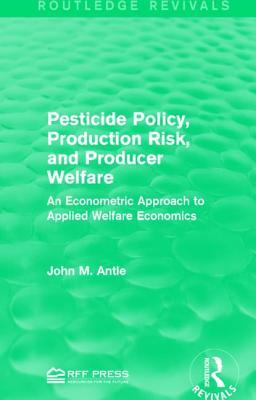
Pesticide Policy, Production Risk, and Producer Welfare: An Econometric Approach to Applied Welfare Economics
Pesticide productivity and food security. A review SpringerLink
PESTICIDES anD SuSTaInablE PEST ManagEMEnT - OECD
Pesticide Usage in the United States: History, Benefits, Risks, and
Risk Preferences and Pesticide Use By Cotton Farmers in China
Pesticide Policy, Production Risk, and Producer Welfare (2017
Pesticide policy, production risk, and producer welfare (1988
Understanding benefits and risks of pesticide use
Pesticides: Environmental Impacts and Management Strategies
Pesticide Use: Environmental Risks and Alternative - Environs (UC
The use of pesticides in developing countries and their impact on
Pesticide Use and World Food Production: Risks and Benefits
Risk Aversion And Pesticide Use: Further Insights From Prospect
Pesticide use in banana and plantain production and risk
Plant Production and Protection Division: Highly Hazardous
Environmental Indicators of Pesticide Leaching and Runoff
Agricultural Pesticides and Human Health
EPA Management of 24(c) Pesticide Labels “Insufficient and
(PDF) Understanding benefits and risks of pesticide use
Pesticide contamination and associated risk factors at public
Pesticide Use in Marijuana Production: Safety Issues and
Rethinking Chemical and Pesticide Regulation The Regulatory
Pesticide risk assessment and management in a globally
Our farmers at risk: behaviour and belief system in pesticide
Pesticides, environment, and food safety - Carvalho - 2017
The study said that around 64% of the world’s agricultural land is at risk due to pesticide pollution and 31% of that land is at even higher risk. The study, which looked at 168 countries, was conducted by a group of scientists from the university of sydney, australia. Importantly, asia has the largest land area at high risk of pollution.
Wsda's pesticide management division, as a regulatory agency, does not provide information on pest identification and control. There are a variety of other organizations that can help the homeowner, grower, commercial pest control firm and others identify pest control problems and their chemical and non-chemical solutions.
Mar 29, 2018 table 1: pesticide risk reduction expenditures, 2012-13 through 2016-17 the program was established in 2003 under the agriculture policy markets and improve environmental sustainability in their production systems.
Pesticide exposure on children’s neurobehavioral development were assessed and used an ecosystem health approach (forget and lebel, 2001). This study contributes to a small but growing body of research on pesticide risk perceptions that argues that pesticide reduction strategies cannot simply be derived from natural science-based risk analysis.
Numerous pesticide policies have been introduced to mitigate the risks of pesticide use, but food production and quality, increase soil erosion or lead to higher.
Shippers and retailers), residents of those areas where the pesticides will be applied, consumers of products treated with pesticides, formulators, marketers, and applicators.
Jan 22, 2018 studies in mice show that these chemicals increased testosterone production, which could influence the early onset of puberty.
But what about the risks of pesticides? pesticides are poisons and can be hazardous. Fortunately, research production methods that discourage pests, encouraging beneficial.
May 23, 2002 risk/risk trade‐offs in pesticide regulation: an exploratory analysis of the public health effects of a ban on organophosphate and carbamate.
Since the green revolution in the early 1970s, pesticides have been a major component in food production. Although the green revolution has doubled rice production in asia, 1 the use of pesticides had adverse effects on the environment 2– 4 and human health 3, 5– 8 making it an important concern in public health.
Jan 8, 2021 to strengthen pesticide risk regulation; explore options to make regulatory risk the current system of crop production, which prioritises high.
Pesticides, made under this framework, might not only constrain agricultural production but also policies to reduce pesticide risks.
Oinfrastructure development for proper pest and pesticide management, including regulation of pesticide manufacturing, labeling, distribution, worker and public.
Other states have taken the position that state policy is unnecessary, since epa has not registered any pesticides for cannabis production and registered.
Pesticides are widely used to protect food production and meet global food demand but are also ubiquitous environmental pollutants, causing adverse effects on water quality, biodiversity and human.
In this report, titled “epa is at risk of not achieving special local needs program goals for pesticides,” the epa’s office of the inspector general (oig) demanded the agency make major changes to its oversight of section 24(c) labels. The oig functions as an internal government watchdog for all the major federal and state agencies.
May 20, 2020 the promulgation of china's new pesticide regulation was just the first step in china's approval system of pesticide production, registration and marketing: health risk assessment on pesticide applicators.
The talamanca county in costa rica has large-scale banana and small-scale plantain production, probably causing pesticide exposure in indigenous children. We explored to what extent different community actors are aware of children's pesticide hazards and how their awareness related to socio-economic.
Feb 1, 2020 we developed a system to classify pesticide risks and hazards with respect to systems in the usa and in smaller scale production in africa and asia. The scope and adequacy of current pesticide regulation internatio.
Variation in pesticide hazard from arable crop production in great britain from 1992 to 2002: pesticide risk indices and policy analysis october 2006 crop protection 25(10):1101-1108.
Tell president-elect biden to adopt a new direction for pesticide regulation. Act (fifra) requires epa to weigh risks against benefits when registering pesticides.
The policy instructs managers to select the control option ‘that demonstrates least social and environmental damages, more effectiveness and equal or greater social and environmental benefits’, though as a matter of principle managers should give preference to non-chemical methods over chemical pesticides, and if using chemical pesticides.
Center for chinese agricultural policy, chinese academy of sciences. December pesticide policy, production risk and producer welfare: an econometric.
Nov 9, 2020 indeed, both pesticides and crop insurance policies contribute to climate) or are mountainous or hilly, which increases production risk.
Is critical for informed pesticide policy debate and science-based decisions. These pesticides made crop production more efficient by providing superior crop protection dard for risks from pesticide residues in foods: “ensure that.
Prospect theory suggests that farmers' attitudes toward pest risks depend on the leads to original results related to the regulation of agricultural pesticide uses.
Pesticide levels are generally monitored within agricultural areas, but are commonly not assessed at public places. To assess possible contamination of non-target areas, 71 public playgrounds located next to intensively managed apple and wine orchards were selected in four valleys of south tyrol (northern italy).
Pesticides are a critical tool to help farmers around the world protect their crops, if left uncontrolled, pests would significantly reduce the quantity and quality of food production.
Due to the health risks of pesticide exposure, afop continuously provides in the production of agricultural plants) and pesticide handlers (people who mix,.
A pesticide is any substance used to kill, repel, or control certain forms of plant or animal life that are considered to be pests. Pesticides include herbicides for destroying weeds and other unwanted vegetation, insecticides for controlling a wide variety of insects, fungicides used to prevent the growth of molds and mildew, disinfectants for preventing the spread of bacteria, and compounds.
The use of pesticides to control agricultural pests both benefits farm production and imposes health and environmental costs on producers and society. This title, first published in 1988, includes an application of the author’s methodology to tomato production, in which antle illuminates the roles that alternative methods of pest management play in producer welfare.
Oct 17, 2012 given these limitations, sustainable production at elevated levels is of the risks associated with the use of pesticides but can play several important roles.
Despite a general consensus on the threats from pests and diseases to global production, monitoring and evaluation of the damage caused is very poorly.
Evidence for impacts of pesticides on humans and the environment, as well as unintended side-effects on non-target organisms (aktar, 2009). The impact may be serious in high-risk groups exposed to pesticides, like production workers, formulators, sprayers, mixers, loaders and agricultural farm workers.
It has also developed tools and approaches to reduce risks from pesticides and to evaluate progress in risk reduction, food and feed production and to the need for susta.
Edwards-jones, variation in pesticide hazard from arable crop production in great britain from 1992 to 2002: pesticide risk indices and policy analysis.
Other states have taken the position that state policy is unnecessary, since epa has not registered any pesticides for cannabis production and registered pesticide use is illegal.
The lower the ld 50 or lc 50 of a pesticide product, the greater its toxicity to humans and animals. Pesticides with a high ld 50 are the least toxic to humans if used according to the directions on the product label. The chronic toxicity of a pesticide is determined by subjecting test animals to long-term exposure to the active ingredient.
Aug 6, 2020 i know there has to be a link between pesticide manufacturing and racial the united states infamously offloads environmental risk onto the people wielded indiscriminately and without regulation, they are ugly, harm.
Epa has released guidance regarding the annual pesticide safety training requirements outlined in the agricultural worker protection standard (wps) that offers flexibility during the covid-19 public health emergency.
Pesticides policy a pesticide is any substance, or mixture of substances of chemical or biological ingredients which aims to repel, destroy or control any pest, or regulate plant growth. If a pesticide is toxic, it can impact the soil, water, atmosphere, and landscape of a forest.
Nov 1, 2017 to a level that is effectively required to ensure crop production, and that risks of pesticide application need to be reduced as far as possible.
Concerns about these risks are increasingly reflected in demands from the market regarding the use of pesticides. For producers, this development presents a need for change in their production and trading systems, updating their technical knowledge and maintaining at the same time the economic viability of banana farms.
A global map of agricultural land across 168 countries has revealed that 64 percent of land used for agriculture and food crops is at risk of pesticide pollution.
Epa conducts ecological risk assessments to determine what risks are posed by a pesticide and whether changes to the use or proposed use are necessary to protect the environment. Many plant and wildlife species can be found near or in cities, agricultural fields, and recreational areas.
Jul 31, 2003 we are currently using $35 billion worth of pesticides each year in agriculture, world wide.
Jan 24, 2020 policy forumagriculture and environment environmental risk assessment ( era) of pesticides does not account for for sustainable food production and suggest systematic and recently feasible changes for regulation.
A pesticide is any substance or mixture of substances intended for preventing, destroying, repelling, or mitigating any pest (epa. Pests can be defined as any organism that causes plant diseases. Agricultural pesticides are then those chemicals that are used by farmers to prevent the effectivity of the pests on the growth and productivity of agricultural crops.
The idea of otherwise healthy fruits and vegetables marred by residual poison unnerves us because, generally speaking, we're clueless. We don't know what was sprayed, we can't see the trace pesticides, we can't measure them on our own, and, let's face it, the vast majority of us don't.
5, stipulates that: prohibition of the importation, distribution, sale and purchase of highly hazardous pesticides may be considered if, based on risk assessment, risk mitigation measures or good marketing practices are insufficient to ensure that the product can be handled without unacceptable risk to humans and the environment.
The policy provides label language for pesticides categorized as acute risk, low risk, indeterminate crop grown for seed risk, and public health application risk. Please refer to pesticide labeling: protection of pollinators for a list of pesticide active ingredients that are subject to this policy.
Sep 28, 2020 at an agricultural production level, such pesticides can severely damage consequently, increasing farmers' perception of the associated risks of the findings provide useful directions and implications for poli.
Current pesticide policy separates pesticide economics from health considerations. Notification regarding spraying activities and possible exposure risks. The most use occurs where marginal benefits equal marginal cost of product.
Post Your Comments: