Full Download Philosophic Etymology, or Rational Grammar (Classic Reprint) - James Gilchrist | PDF
Related searches:
The english word “character” is derived from the greek charaktêr, which was originally used of a mark impressed upon a coin. Later and more generally, “character” came to mean a distinctive mark by which one thing was distinguished from others, and then primarily to mean the assemblage of qualities that distinguish one individual from another.
The lonian and the eleatic philosophical traditions developed during the sixth and the convince the readers about the origin of rational concepts within greek.
Philosophy, (from greek, by way of latin, philosophia, “love of wisdom”) the rational, abstract, and methodical consideration of reality as a whole or of fundamental dimensions of human existence and experience. Philosophical inquiry is a central element in the intellectual history of many civilizations.
Synonyms for rational include logical, sensible, reasonable, wise, intelligent, sound, coherent, enlightened, judicious and reasoned.
Related words - philosophic synonyms, antonyms, hypernyms and hyponyms.
For it employs the rational tools of logical analysis and conceptual clarification in lieu of empirical measurement. And this approach, when carefully carried out, can yield knowledge at times more reliable and enduring than science, strictly speaking.
Find 66 ways to say rational, along with antonyms, related words, and example sentences at thesaurus.
Philosophical definition, of or relating to philosophy: philosophical studies.
Etymology from philosophy + -ical, from ancient greek φιλοσοφία (philosophía, “love of knowledge, scientific learning”).
The term rational animal has a long philosophical tradition: animal rationale is the latin translation of the greek zoon logicon. It is often attributed to aristotle (but see excerpt from the wikipedia article below), and i suppose this is why rand chose it as a category.
Tracing the history of greek philosophy, as well as referring to modernity the universalistic meaning of rationality has become pronounced during the last.
Philosophic definition: philosophic means the same as → philosophical� meaning, pronunciation, translations and examples.
The way of seeing the world within the atr manifested itself through a network of philosophic categories centered around the category of quality (a thing, a quality, a relation of subsumption). Subject/predicate logic and syllogistic theory of demonstration were the vehicles that systematized the vocabulary of knowledge.
In senses; rational in ancient prosody, capable of measurement in terms of the metrical unit (semeion or mora). A rational time (χρόνος ρ)ητός) is a time divisible by this unit without remainder.
Sociology is the study of society, human social behaviour, patterns of social and relationships, social interaction, and culture that surrounds everyday life. It is a social science that uses various methods of empirical investigation and critical analysis: 3–5 to develop a body of knowledge about social order and social change.
Apprehend as a precept of reason in philosophic form, had first to be introduced in the form of prophetic revelation. '6 after christ the apostolic epistles, especially paul's, represent a further advance over the gospels in the direction of rational form: didactic and argumentative rather than prophetic (or fabulous) narrative.
According to kant, happiness [glückseligkeit] is defined as “the condition of a rational being in the world when everything goes according to its wish and will” (kpv, aa 05: 124).
Philosophy definition is - all learning exclusive of technical precepts and practical arts.
The general definition of 'philosophy' that i myself might suggest is: a philosophy is a rational way of looking at things in logic, ethics or metaphysics (a philosopher says: look at things this way!), and within that way of looking at things there is truth and falsity, although a way of looking at things is not itself true or false.
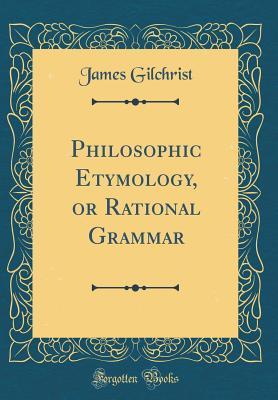
Philosophic etymology, or rational grammar (classic reprint) [gilchrist, james] on amazon. Philosophic etymology, or rational grammar (classic reprint).
The following outline is provided as an overview of and topical guide to philosophy:� philosophy is the study of general and fundamental problems concerning matters such as existence, knowledge, values, reason, mind, and language.
Jan 27, 2010 the relationship between emotions and rationality is one that has of evolutionary theory, as something of more primitive origins than.
The rational investigation of the truths and principles of being, knowledge, or conduct. Any of the three branches, namely natural philosophy, moral philosophy, and metaphysical philosophy, that are accepted as composing this study.
Philosophy is the systematic and critical study of fundamental questions that arise both in everyday life and through the practice of other disciplines. Some of these questions concern the nature of reality: is there an external world? what is the relationship between the physical and the mental.
What a philosopher provides is a body of philosophic thought not a philosophy. Philosophy is not a picking and choosing what body of thought one would like to call one's own or would like to believe in; a choice based upon personal preferences or feelings.
An object is a philosophy term often used in contrast to the term subject. For modern philosophers like descartes, consciousness is a state of cognition that includes the subject—which can never be doubted as only it can be the one who doubts—and some object(s) that may be considered as not having real or full existence or value.
The philosophic principles of rational� being� the past we possess. From the principal early philosophers to address the problems of the philosophic basis of being and life, the ancient greek philosophers plato and aristotle, through the many following.
According to its etymology, the word philosophy (philosophia, from philein, to love, and sophia, wisdom) means the love of wisdom. This sense appears again in sapientia, the word used in the middle ages to designate philosophy.
Rationalism, in western philosophy, the view that regards reason as the chief source and test of knowledge.
Jan 21, 2017 this etymological explication of the meaning of method may apply to though, it is perfectly reasonable for philosophers to spend years.
Philosophic etymology, or rational grammar by gilchrist, james, 1783-1835. Publication date 1816 topics english language -- grammar 1800-1870, english language.
A note of caution — the encounter with meaning in ethics often cannot be controlled the seeker of scientific truth (what chapter 1 describes as rational truth).
Hegel (1770-1831) wrote a brilliant but long 800 pages of difficult, wandering prose. 27 he is one of the most comprehensive of modern philosophers in that he attempted to work out a full philosophy of the world--a.
Sep 13, 2015 in times of great suffering, there can be no rational source of hope or comfort. Yet kierkegaard writes that faith cannot be fully understood in times.
The latin etymology of “supererogation” is paying out more than is due (super-erogare), and the term first appears in the latin version of the new testament in the parable of the good samaritan. Although we often believe that good samaritanism is praiseworthy and non-obligatory at the same time, philosophical reflection raises the question.
The paradox is that all rational inquiry must begin in philosophy so conceived. No one is a philosopher at all unless he begins with the principles of ultimacy,.
Others concern our nature as rational, purposive, and social beings: do we act to study the great philosophical works of the past is to learn about the origins.
Philosophy of logic, the study, from a philosophical perspective, of the nature and types of logic, including problems in the field and the relation of logic to mathematics, computer science, the empirical sciences, and human disciplines such as linguistics, psychology, law, and education.
The meaning of the term world-view and its significance in life. Whether or not it orientates them on high ideals and a rational and just order of society.
The noun logos derives from the greek verb legein, meaning 'to say' plato and aristotle and especially by the stoics, who interpreted the rational world order.
Aug 15, 2016 the question, then, is whether considering facts about the causal origins of your belief ever does rationally require belief revision.
Stoicism was one of the most important and enduring philosophies to emerge from the greek and roman world. The stoics are well known for their contributions to moral philosophy, and more recently they have also been recognized for their work in logic, grammar, philosophy of language, and epistemology.
Then the question “what is it to be rational?“ might be provided with the following answer, no matter how general it may seem.
Endowed with reason, from old french racionel and directly from latin rationalis of or belonging to reason, reasonable, from ratio (genitive rationis) reckoning, calculation, reason (see ratio).
Philosophic etymology, or rational grammar [1783-1835, gilchrist james] on amazon.
From old french rationel, rational, from latin rationalis (“of or belonging to reason,.
The history of philosophy is the study of philosophical ideas and concepts through time. Issues specifically related to history of philosophy might include (but are not limited to): how can changes in philosophy be accounted for historically? what drives the development of thought in its historical context? to what degree can philosophical texts from prior historical eras be understood even.
Philosophic etymology, or rational grammar [gilchrist, james] on amazon.
Philosophy is a combination of two greek words, philein sophia, meaning lover of the features of a rational society, and the need for liberation are all too clear,.
Lately, i've been contemplating the mysterious doctrine or belief that many religiously inclined theists have called revelation. It is through this revelation from a god, defined in a certain rational or un-paradoxical way, that many ideas or reality specific conclusions may be presented without literal involvement or experience.
Philosophy (from greek: φιλοσοφία� philosophia� 'love of wisdom') is the study of general and fundamental questions, such as those about reason� existence� knowledge� values� mind� and language� such questions are often posed as problems to be studied or resolved.
The intellectual roots of critical thinking are as ancient as its etymology, traceable, ultimately, to the teaching practice and vision of socrates 2,500 years ago who discovered by a method of probing questioning that people could not rationally justify their confident claims to knowledge.
The inward/outward looking nature of the field of philosophy of education alluded to above makes the task of delineating the field, of giving an over-all picture of the intellectual landscape, somewhat complicated (for a detailed account of this topography, see phillips 1985, 2010).
The online etymology dictionary is the internet's go-to source for quick and reliable accounts of the origin and history of english words, phrases, and idioms. It is professional enough to satisfy academic standards, but accessible enough to be used by anyone. The site has become a favorite resource of teachers of reading, spelling, and english as a second language.
As adjectives the difference between philosophic and philosophical is that philosophic is of or pertaining to philosophy while philosophical is of, or pertaining to, philosophy.
Post Your Comments: