Full Download Direct Deliberative Democracy: How Citizens Can Rule - Jack Crittenden | PDF
Related searches:
Indeed deliberation might well have prevented the evils of more direct democracy as experienced by the ancient athenians.
Deliberative democracy – informed and moderated discussion that transcends partisan identities – can lead to a depolarized and more democratic society, according to stanford research.
Liberal democracy around the world is in crisis (galbraith, 1993; dalton, 2004: 28 and 30; 2006: 59; stoker 2006, hay 2007) and deliberative democracy is increasingly seen as the solution. If deliberative democracy really is to be the saviour, however, there are a number of vital issues that still.
Deliberative democracy or discursive democracy is a form of democracy in which deliberation is central to decision making. It adopts elements of both consensus decision-making and majority rule. Deliberative democracy differs from traditional democratic theory in that authentic deliberation, not mere voting, is the primary source of legitimacy for the lawmaking processes.
Pdf direct-democratic processes have won popular support but fall far short of the standards of deliberative democracy.
Necessitates a new definition of democracy in which to frame a call for reforms. Progressive direct democracy reforms (initiative, referendum, recall, and direct primaries) succeeded in limiting the power of political parties. Progressives wanted city contracts to be awarded on the basis of what you know.
The notion of deliberative democratic decision-making might be aptly characterized as transposing the latter into a social key—“thinking slow together.
The interactions we observe challenges assumptions of democratic deliberation as mainly policy debate between citizens and government, or of lobbying.
Mar 15, 2019 social science on “deliberative democracy” offers reasons for optimism or they could involve more direct deliberative exchanges between.
Direct democracy enables the public to decide on policy decisions without a proxy, typically through ballot measures or referenda. California is well-known for its use of direct democracy in its many ballot propositions, a practice that started in 1911. The counterpart to direct democracy is called deliberative democracy.
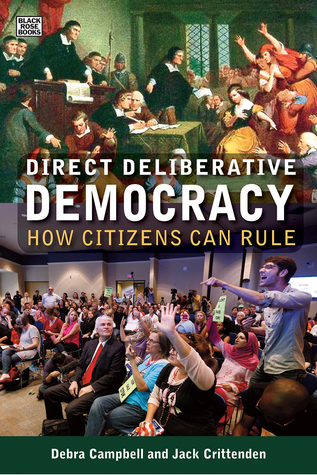
Left out in the cold by the political process, citizens are frustrated and despairing. How can we take back our democracy from the grip of oligarchy and bring power to the people? in direct deliberative democracy, jack crittenden and debra campbell offer up a better way for government to reflect citizens’ interests. It begins with a startlingly basic question: “why don’t we the people govern?”.
Nov 17, 2020 deliberative democracy is a theoretical model for a kind of government that emphasizes equal political participation in a public forum.
A direct democracy is where the demos votes directly on the proposals, not for representatives who will then vote on the proposals. A deliberative democracy is one in which the focus is put on deliberation.
From regular to deliberative constitutional politics� despite the formal concerns, belgian regions and communities have taken a crucial step in experimenting with an innovative institutionalization of direct citizen participation in policy deliberation and formulation complementing regular political institutions.
Website of the directorate for public governance at the oecd, a source of policy solutions, data, expertise and good practice. Public authorities from all levels of government increasingly turn to citizens' assemblies, juries, panels and other representative deliberative processes to tackle complex policy problems ranging from climate change to infrastructure investment decisions.
This article argues that advocates of deliberative democracy, on the one hand, and direct democracy, on the other, ought to engage with each other's.
Deliberative democracy incorporates the requirements that deliberation take place in contexts of equal recognition, respect, reciprocity, and sufficiently equal power for communicative influence to function.
About deliberative democracy and how it might be a perfect fit for the maldives. Deliberative democracy is a form of direct democracy that has learnt from the pitfalls of earlier experiments in direct democracy. A common leftist goal, it has only taken place in a few limited situations so far around the world.
The course presents a comprehensive survey of the deliberative democracy literature, joshua cohen and charles sabel, directly deliberative polyarchy.
Jun 21, 2018 deliberative democracy is fundamentally different from the representative and direct democracy models that provide citizens a guaranteed vote,.
� ideals of democratic participation and rational self-government have long informed modern political theory.
In direct deliberative democracy� jack crittenden and debra campbell offer up a better way for government to reflect citizens' interests. It begins with a startlingly basic question: why don't we the people govern?.
Deliberative democracy contrast with interest-based democracy in several ways. Deliberative democracy encourages the meeting of people to decide public ends and policies through rational discussion. And a consensus is the preferred outcome of such discussions.
While drawing on the rich theoretical literature about deliberative democracy, leib of government that would inject direct popular deliberation into law- making.
Jun 19, 2018 firat cengiz writes that democracy in the eu would benefit from methods allowing citizens to participate more directly in policymaking.
Some practitioners and theorists use the term to encompass representative bodies whose members authentically deliberate on legislation without unequal distributions of power, while others use the term exclusively to refer to decision-making directly by lay citizens, as in direct democracy. Deliberative democracy holds that, for a democratic decision to be legitimate, it must be preceded by authentic deliberation, not merely the aggregation of preferences that occurs in voting.
Of deliberative democratic theory deliberation is directly related.
What is deliberative democracy? most fundamentally, deliberative democracy affirms the need to jus-tify decisions made by citizens and their representatives. Both are ex-pected to justify the laws they would impose on one another. In a democracy, leaders should therefore give reasons for their decisions,.
Assistant professor, department of philosophy, huron university college.
Examples of direct democracy: athens and switzerland� perhaps the best example of direct democracy existed in ancient athens, greece. While it excluded many groups including women, enslaved people, and immigrants from voting, athenian direct democracy required men over the age of 20 to vote on all major issues of government.
Direct democracy is a system where people decide on and vote on policy initiatives and laws directly, using several instruments like referendum, initiative and recall. Referendum mainly implies that a bill that has been passed in the legislature will be obliged to be set for a popular vote.
According to wikipedia: deliberative democracy or discursive democracy is a form of democracy in which deliberation is central to decision making.
Ted becker noted that in direct democracy the flow of information and the deliberative process is lateral among citizens, in the representative form however, the flow of information is usually from the candidates and officials to the public, on a downward trajectory (becker and slaton.
Athenian democracy was both deliberative and largely direct: some decisions were made by representatives but most were made by the people directly. When democracy was revived as a political system about 2000 years later, decisions were made by representatives rather than directly by the people.
Mantle of deliberative democracy fits rawls better than gauthier for this reason. If one's preferences are best served either directly or indirectly by it, a purely.
Deliberative democracy is a field of political inquiry that is concerned with improving collective decision-making. It emphasizes the right, opportunity, and capacity of anyone who is subject to a collective decision to participate (or have their representatives participate) in consequential deliberation about that decision.
Democratic process and the (in some circles, dominant) deliberative model of democracy. The direct rabbit in the polyarchal hat new (radical, discursive, deliberative) models of democracy often take what they see as the standard master institutions of liberal democracy – the lockean trinity in essence – and leave them.
Vancouver direct deliberative democracy: how citizens can rule - with money, lobbyists, and corporations now dominating local, state, and national elections, campbell and crittenden argue that now is the time for citizens to take control of their lives by deliberating together to make laws directly.
Keywords: deliberative polling; deliberative democracy; political equality; in- formed opinion has seen a general trend toward ever more direct democracy.
Mar 3, 2020 whereas direct democracy tends to polarize, deliberative democracy seeks to overcome polarization and create consensus.
The institutions of empowered deliberative democracy operate in a complex web of more conventional arrangements that includes interest groups and politicians contesting one another in agencies, legislatures, and courts.
(deliberative for active citizens, just aggregative for lazy ones).
The models of direct and deliberative democracy are broadly considered the major alternatives to representative democracy. So far, the two models have been merged under the broad umbrella of participatory democracy and thus little is known about why citizens support direct democracy and/or deliberation.
Policy develoment as well as constitutional review process are characterized by participatory democracy. What are the online and offline instruments (blended participation) implemented. What are the benefits -what are the problems? is gamification a sucessfull strategy? this open meeting of the ddd (direct and deliberative democracy)- group.
Direct democracy, also called pure democracy, forms of direct participation of citizens in democratic decision making, in contrast to indirect or representative democracy. Direct democracies may operate through an assembly of citizens or by means of referenda and initiatives in which citizens vote on issues instead of for candidates or parties.
Direct-deliberative e-democracy, attempts to resolve the theoretical problems of rousseau's general will through the technical means provided by various modern technologies. Behrouzi argues that the us has the material and technological means, as well as the political-cultural institutions, needed to actualize rousseau's idea of the direct exercise of individuated sovereign powers in an electronically amalgamated general will.
Democracy realizes a kind of equality among persons that all can share allegiance to even when they disagree about many matters relating to substantive law and policy. Since democracy realizes equality in a highly public manner and publicity is a great and egalitarian value, the equality realized by democracy trumps other kinds of equality.
Deliberative democracy should not be confused with direct democracy. For example, it might be suggested that citizen participation in local policy issues should.
Direct democracy previews that people can vote on different topics, having usually a binary choice; the policy making process is distinct from that of decision making. An example of direct democracy is the referendum, an institution which is also present in many liberal democracies (both in consultative and abrogative forms).
The theoretical critique of liberal democracy and revival of par-ticipatory politics gradually developed through the 1970s. 9 it was only in the 1980s, however, that a concept of deliberative democracy began to take deªnite shape. The term “deliberative democracy” seems to have been ªrst coined by joseph bessette, who argued.
The 3 desirable criteria of direct democracy (participation, deliberation, and equality) are all different vertices of the same triangle. Because deliberation requires more organisation, it is also harder to scale. That’s why it works best with small, representative samples of the population.
How can we take back our democracy from the grip of oligarchy and bring power to the people? in direct deliberative democracy, jack crittenden and debra campbell offer up a better way for government to reflect citizens' interests. It begins with a startlingly basic question: why don't we the people govern?.
Some scholars think that deliberative democracy is the governance form in which different political parties, political organizations, and citizens give legislation and decision-making legitimacy through taking part in legislation and decision-making.
Every election cycle a great number of citizens take to the polls to vote on public policy matters directly. And an account of deliberative democracy—far from being a source to critique direct democracy—might provide a solution. First, i hope to identify some problems with the mechanisms of direct democracy that most states and many.
Direct-democratic processes have won popular support but fall far short of the standards of deliberative democracy.
In general, the term direct democracy usually refers to citizens making policy and law decisions in person, without going through representatives and legislatures. The classic example of this is the new england town meeting where anyone.
Direct democracy, on the other hand, is viewed as undermining deliberation in favor of greater participation. Direct democracy gives every person a voice regardless of the time they have devoted to reflection on the issue or policy at hand. In contrast, deliberative democracy strives to design institutions that encourage reflection and consideration before decisions are made.
Deliberative democracy has been the main game in contemporary political theory for two decades and has grown enormously in size and importance in political.
Talk of deliberative democracy is to be justified ~goodin 1999. But i think that it is better to leave that question open and to take the centralised or collective picture of deliberative democ-racy as a more specific version of a broader ideal. The discursive dilemma so much for the different elements in the ideal of deliberative democracy.
Most crucially, deliberative participants have to presuppose that anyone can take part in discourse and anyone can introduce and challenge claims that are made there. They must also see one another as equals, reciprocally granting one another equal status in deliberation.
Apr 8, 2019 deliberative democracy means citizens communicating about and here comes from direct observation of citizen deliberation in minipublics,.
In this respect deliberative democracy stands in contrast to rousseau's conception of democracy, in which individuals reflect on their own on what is right for the society as a whole, and then come to the assembly and vote in accordance with the general will. 2 the other sense in which the reasons must be public concerns their content.
Deliberation must become the affair of representatives, rather than directly that of citizens them- selves, in order to be truly democratic.
Forms of direct democracy in this primer, the term ‘direct democracy’ is used to designate mechanisms that enable the electorate to vote on a specific law, treaty, constitutional amendment, policy or other public decision.
Deliberative democracy is based not on a competition between conflicting interests but on an exchange of information and justifications supporting varying perspectives on the public good. Ultimately, citizens should be swayed by the force of the better argument rather than by private concerns, biases, or views that are not publicly justifiable to their fellow deliberators.
Policy develoment as well as constitutional review process are characterized by participatory democracy. According to the principle first talk then vote, deliberative and direct democratic instruments become more important. What are the online and offline instruments (blended participation) implemented.
Deliberative democracy is harmonious with both representative democracy and direct democracy. Some practitioners and theorists use the term to incorporate representative bodies whose members authentically deliberate on legislation without unequal distributions of power, while others use the term exclusively to refer to decision-making directly.
Under a deliberative model, citizens make political choices freely, following extensive debate and discussion regarding the implications and consequences of those choices, both for themselves as individuals and, for the society as a whole.
May 28, 2019 deliberative democratic theory emerged as a challenge to this skepticism a range of more direct deliberative decision-making practices have.
Popular vote processes, institutional design, direct democracy, democratic systems, deliberative democracy.
Two leading forms of direct democracy are participatory democracy and deliberative democracy. Semi-direct democracies, in which representatives administer day-to-day governance, but the citizens remain the sovereign, allow for three forms of popular action: referendum (plebiscite), initiative, and recall.
Deliberative democracy is different from representative democracy because it puts conversations, diverse perspectives and understanding at the centre of the decision rather than relying on polling and voting.
Deliberative democracy or discursive democracy is a form of democracy in which deliberation is central to decision-making. It adopts elements of both consensus decision-making and majority rule.
It is the latest development in a new wave of contemporary deliberative democracy, based on the premise that political decisions should be the result of reasonable discussion among citizens. The council’s inaugural twenty-four members will rotate out over an eighteen-month period; every six months, eight members will be replaced by a new group. 2 new members will be randomly invited through a civic lottery�.
Direct democracy allows you to vote on bills and decisions being debated in parliaments and councils. If voters vote with a majority, pd politicians are contracted to vote with you on bills and decisions. Deliberative democracy allows you to debate and discuss bills and decisions before voting.
In a deliberative democracy, citizens invest time to deliberate or authentically weigh all arguments before voting or deciding by consensus on the laws which will govern them. If citizens cannot come to a consensus after deliberation, then laws are enacted by majority vote. This deliberative process is what gives laws their legitimacy.
Jul 3, 2018 deliberative democracy has its roots in the athenian-style democracy that short -term nature more direct or representative types of democracy.
This essay introduces the alternative potential of deliberative democracy, and to illuminate the weaknesses of plebiscitarian methods of “direct” democracy,.
Post Your Comments: